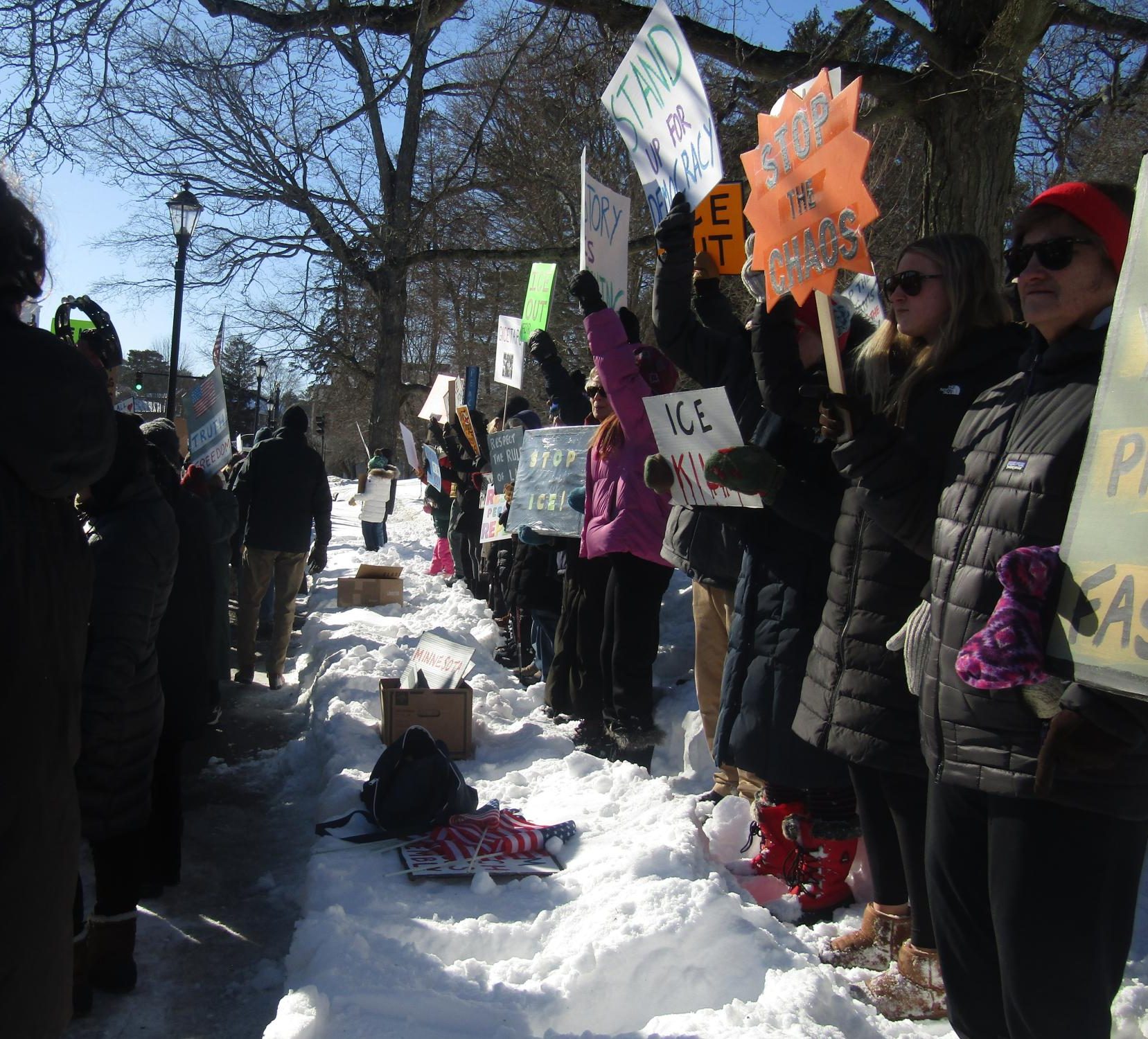
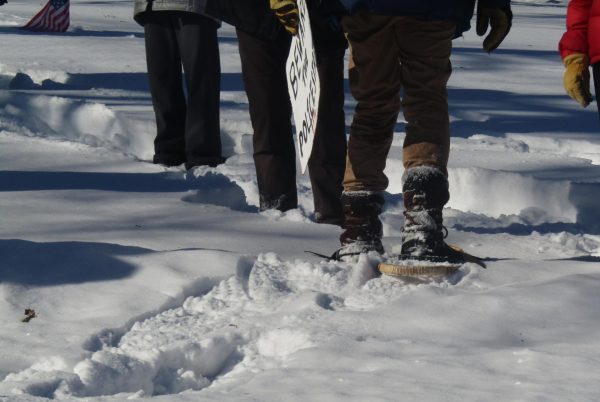
Cold winds cut through winter coats as snow and ice crunched underfoot along Central Street. With snowbanks climbing nearly to knee height, protesters boxed into tight clusters along both sides of the street in long lines. At one point, a row of elder protesters stomped their feet in unison with chants, attempting to create warmth against the strong winds.
While massive crowds nationwide walked out as part of the “National Shutdown” protest against U.S. Immigration and Customs Enforcement (ICE) occurred across the country — including a rally in Boston the same afternoon — a smaller crowd of around a hundred gathered in Wellesley.
For some protesters, the choice to stand here, rather than elsewhere, was intentional. Wellesley resident Diane Heman chose Wellesley over the Boston protest.
“I think the more places that we can show support for fellow Americans, our immigrants, our people of color, everyone who deserves to live and not be executed in the streets, [the better],” said Heman. “It’s nice to go into Boston, [but] it’s not always that easy, so I think this is great.”
Brian LeMay, a Minneapolis native now living in Needham, originally intended to attend the Boston protest. But due to a canceled train, he felt compelled to stand in Wellesley.
“There was an article in the Times last week, who said that so many people are feeling they have to do… something. They’re not quite sure what, but… they’re right. We have to do something, because tomorrow we might not be able to,” he said.
In Minneapolis, LeMay would often frequent a German bar across the street from the same intersection where Alex Pretti, a 37-year-old intensive care nurse, was fatally shot by ICE officers during an enforcement operation on Jan. 24.
“It’s very emotional,” he said.
Several other attendees felt a personal connection to the recent ICE presence in Minneapolis.
“We lived in Minnesota for a long time, and so everything that is happening just brings it home even more,” said Wellesley resident Cliff Pollan.
Next to him, his wife, Peggy Kriss, became visibly emotional.
“As you said Minnesota, my eyes teared up. It makes you feel like home when you hear about a place you love so much … I’m so happy that everyone cares, and the world is looking,” she said, wiping away tears.
But for Katalin Brown, being present was about consistency, not size..
“It’s not just one afternoon that you go out. It has to be done on a daily basis. … Sometimes just showing up means something.”
However, even amid the chants and music, some protesters could not help but notice some patterns in the crowd. The majority of protesters were older, with only a few children and even fewer people in their twenties or thirties, despite nearby college campuses.
“Having gone to a lot of these and seeing really dedicated people that are [in their] 60s, 70, [and] 80s, and failing to see people that are my generation show up … it’s pretty pathetic, to be honest,” said Needham resident Igor Khislavsky.
Laurie Feinstein, an older protester and longtime activist since the 1960s and 70s, echoed Khislavsky’s observations.
“The young people need to get out here, and they don’t at most of [these] rallies. All I see is a bunch of old white people,” Feinstein said.
As ICE crackdowns increase nationwide, some protestors had a message for leadership in the nation’s capital.
“Open up your hearts. Be honest, be brave, and stop the fascism,” Kriss said. “Stop the killing.”
Contact the editors in charge of this article: Jessica Chen and Lyanne Wang