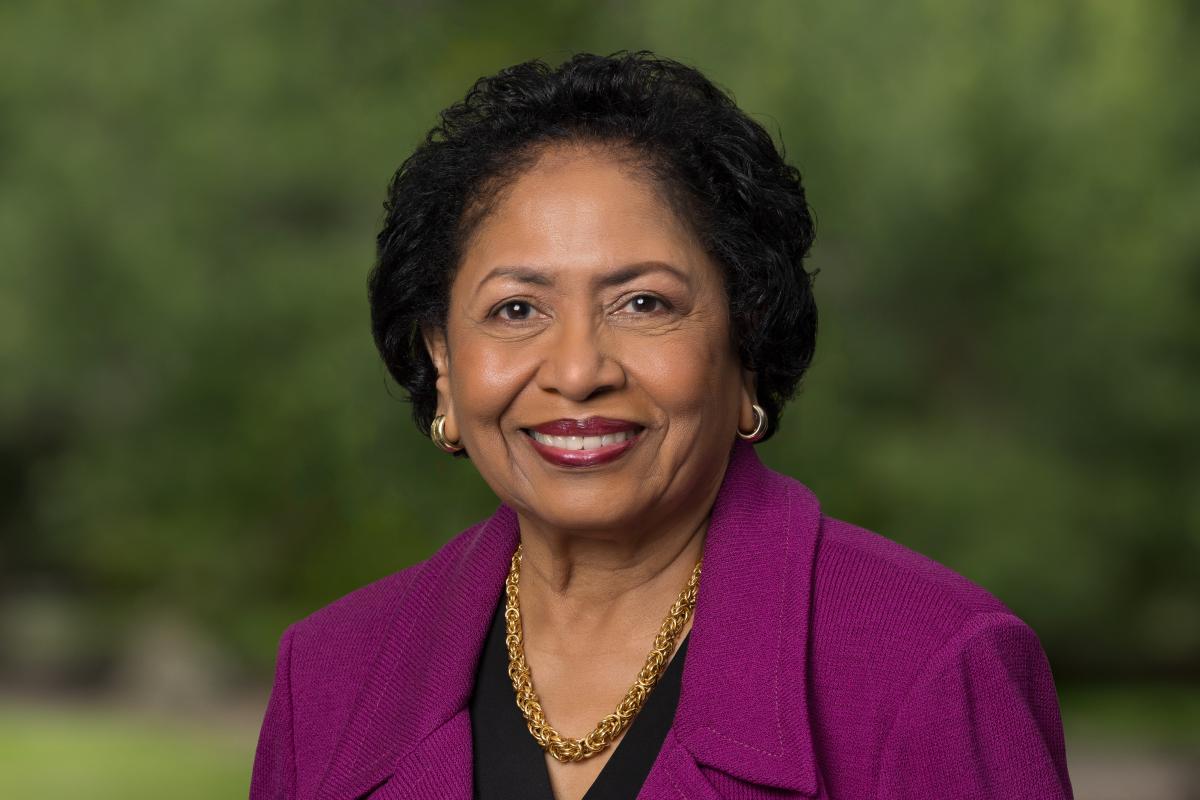
On Friday, March 27, President Paula Johnson announced that Rice University Distinguished Presidential Fellow and MacArthur Foundation board member Dr. Ruth Simmons will deliver Wellesley’s 148th commencement address on May 15.
Simmons, the first Black president of an Ivy League university, also previously served as president of Smith College, another historically women’s college. However, her experience with historically women’s colleges began in 1966, when she spent a year at Wellesley College as a visiting student from Dillard University.
The Wellesley News spoke to Simmons in an interview to discuss her views on women’s education, the political integrity of universities and her experiences with criticism.
The following conversation has been edited and condensed for clarity.
You spent your junior year at Wellesley as a visiting student, and you’ve written that Wellesley changed how you engage with people who hold different points of view. What specifically happened that shifted your thinking?
First, I have to describe the context. I was born in a very different era and grew up in deep segregation. That was a time in the country, especially in Texas, where I was born, where there were no opportunities to interact with people of different backgrounds, different social strata or different outlooks. Until I went to Wellesley, I had never studied in an environment where there were whites or people of different races. Nor, I must say, people of different faiths, or people from the international world.
When I got to Wellesley, there were girls from all kinds of different backgrounds. This was kind of an opening up of the world in a way that stunned me and had a remarkable influence on how I was later to see the world, and what I was to appreciate in the world.
There’s another aspect of Wellesley that was quite different, and that is that the background that I came from was very paternalistic. Men had an important place in the world. Girls were taught to expect little, and not to show any ambition, and certainly no ambition for a career. I had grown up in a household with a dominant father and seven brothers, and my understanding was that, as girls, we were to be of assistance to men, but not aspire independently to do anything.
Imagine coming to Wellesley and seeing women who were independent, who were aspiring to do things with their lives. Most importantly, the place was run by women. I thought that was completely remarkable at the time. I began to think that maybe the horizon that I had imagined for myself might not be the right one. I credit my experience at Wellesley for opening up the world to me in the respect of how I look upon other people, in the respect of how curious I am about the world, in the respect of the goals I’ve set for myself. All of that came with this marvelous year at Wellesley.
What does it mean to return now as commencement speaker?
It’s terrifying. I was thinking about this recently, and chastising myself, because I’ve probably given more than 50 commencement speeches to very large institutions. I’ve given commencement speeches at every place where I’ve been a student. But I never felt threatened, in any sense, by being asked to be the commencement speaker. I thought, “Well, why am I nervous about Wellesley?”, and I think it has to do with how I value my Wellesley experience, and also the fact that Wellesley has never really kept in contact with me, or treated me like an alum. There’s been this distance that I felt between myself and this very important institution to me. I guess that’s part of the reason I’m sort of terrified, because I know it will be an emotional experience for me. I hope that I can manage through that emotional experience to really deliver a sensible speech.
Wellesley is celebrating its 150th anniversary this year. What do you think historically women’s colleges like Wellesley offer that co-ed institutions cannot replicate?
Given the construct of gender in the world, there’s still this overhang that suggests that there are particular roles that are suitable for women rather than for men, and there are certain behaviors and predilections that are suitable for women. Imagine being in a place where none of that is an issue, and you get to be fully who you are, and to aspire fully to anything you dare to be. That’s a luxury that I think women in women’s colleges can still enjoy. I think it’s such an extraordinary opportunity that women have to be in a women’s college.
You’ve led a Seven Sisters college, an Ivy League university and an HBCU. You’ve also been described as someone who calls on universities to “uphold their foundational ideals and reckon honestly with their failures.” In this current political moment, with federal pressure on universities, debates over DEI and campus tensions over free expression, what do you think institutions are getting right? Where are they falling short?
[People] respect institutions that hew to their purpose, their fundamental values. While it might be difficult to do that in the current circumstances, there will be a time when this moment passes, and then people have to assess what universities have done in this period.
I believe that because I’m old enough to have seen this before. As hard as it is to imagine, when I was growing up, public figures were set against giving Blacks their civil rights. What that meant is that institutions then fell in line with that, and they upheld segregation. They fought mightily against admitting students to their institutions, sometimes violently. Certain other institutions and civic organizations did exactly the same. When we look back at that today, those institutions that did that are the object of scorn for what they did in that period. We always look back in history and assess the behavior of actors at the time, in the context of what our shared values are. And those values, believe it or not, don’t change very much over time.
So my advice to institutions today is to hew to those fundamental values. We admire people who stand up for principle. We admire people who do not find themselves subservient to unworthy ideals. I think the thing for universities to do is to be stronger.
Leaders at your level inevitably make decisions that invite criticism – your time on Goldman Sachs’s board being one prominent example. How do you decide when criticism is a signal to change course, and when it can be ignored?
I advocate that one of the best things that you can do as a leader is to come into the leadership position understanding fully what your own beliefs and values are. You have to know very clearly what the most important thing is to you. If you don’t know that, you’ll be buffeted about pretty soundly. I can think of a multitude of times when my own views were not the most popular, and having to push through to remain on course to do the things that I thought would be the most important.
To start with Smith, when I brought up the idea of an engineering program at a women’s college, that was pretty controversial. That was something that just wasn’t done, after all. It’s a liberal arts college, and why would you do something like engineering?
When I went to Brown, people asked a question about slavery, and I said, “Well, if we are asked what the history of slavery’s relationship is to Brown, we must tell the truth about it. ” When I started that, it was resoundingly panned as the wrong course. That was probably the most difficult decision that I had to make in my career, to stick to that. But, of course, it is the decision that I’ve made that has been the most celebrated in my career.
The only thing that helps you get through those periods is having a profound sense of what is right and wrong, a profound sense of what you believe is the right course for your institution and a profound sense of what is the ethical thing to do. Only if you have all of that can you really move forward in controversies, because I can tell you that there are lots of people standing in line to tell you how wrong you are and how you must reverse course.