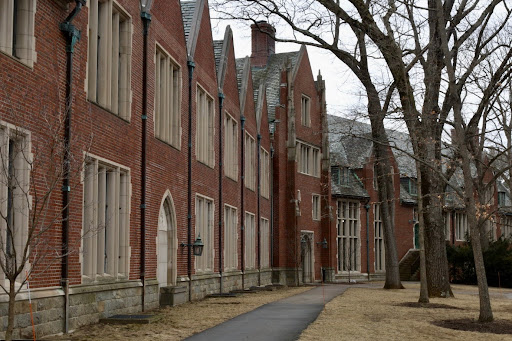
This past weekend, Wellesley hosted two Admitted Student Days, welcoming many new members of the Class of 2030 to campus. I’ve had the pleasure of showing several prospective Wellesley students around campus, and without fail, each one has said, “It’s so beautiful.”
Certainly, Wellesley is gorgeous. But after spending four years here, there’s one consistent complication to our idyllic campus: the construction. Wellesley’s campus has undergone significant renovations in the last few years, accompanied by near-constant discussions about those renovations. Perhaps you’ll abide a long-winded review of those discussions — if you didn’t receive all these emails in real time, hopefully this can offer some insight into the experience.
Renovation discussions showed up in our inboxes the month we arrived on campus as first-years. On Sep. 26, 2022, then-Provost Andy Shennan and Chief Information Officer & Associate Provost Ravi Ravishanker sent an email referencing a College announcement from May 4, 2025, concerning a Board of Trustees decision to allocate $125 million to “urgent repairs” that would “help secure the future of the Wellesley campus.” Some of this money would be directed towards one of the most provocative three-word phrases out there for any current Wellesley sophomore, junior or senior — “the Clapp renovation.”
The library rehabilitation was originally slated to take place from June 2023 to August 2024. However, a message from President Johnson on April 27, 2023, announced that the renovation plan was expanded, and that under the new timeline, Clapp would close in December 2023 and reopen in January 2025.
Clapp closed that December, right after this year’s Wellesley seniors had completed our third semester at the College. It was, as expected, a major change in campus life, and not simply because no one studies more than a Wellesley College student. As one of Wellesley’s few nonresidential buildings open late at night, Clapp was a place to spend hours with friends without bothering your roommate (a requirement for Wellesley students in both their first and sophomore years) and a place to have late-night conversations while studying on the bottom floor that might’ve felt disruptive when even the dorm common rooms grew too quiet.
Though students adapted to the changes to Wellesley life, mourning Clapp was a familiar refrain among students. Then, on Oct. 29, 2024, 10 months into the Clapp closure, another email from Ravishanker noted that the library’s reopening would be delayed again because a large donation allowed for another expansion of the project — Clapp was then slated to reopen in August 2025.
After another semester, at long last, a message from Vice President for Finance and Administration and Treasurer Piper Orton on July 10, 2025, confirmed that Clapp was on track to reopen in the fall semester. By the time Clapp reopened, the Class of 2026’s senior year was beginning.
While we were preparing to have our beloved Clapp back again, however, Orton announced in the same email that the last of the College’s “critical repair projects” was set to begin: Green Hall would close in the fall, with renovations lasting throughout the academic year.
With Green Hall’s closure, in addition to the numerous offices and meeting spaces that have been forced to move yet again, another iconic part of Wellesley’s campus is rendered inaccessible.
To summarize, within four years, we’ve seen the closure of the library — the spatial model of exactly what students come to college for — and then the subsequent closure of Green Hall, the focal point of nearly every photograph of campus.
Less visible renovations have also impacted Wellesley. After Clapp closed, thesis carrels were moved to several locations, including the Claflin basement, the previous home of Wellesley Drag. As a Wellesley first-year, I, with many of my peers, spent many of my Saturdays in the Claf basement, sitting on the unforgettable black and white chess-tile floors, listening to music playing out of a loud-but-could-have-been-louder speaker and performance announcements from a microphone that garbled the emcees’ voices. After the Clapp renovation was finished, Claflin underwent its own set of projects, including removing those black and white floors in a complete basement remodel. On its own, it was a small renovation, but the effects of all these renovations are multiplicative.
Sure, it can be bothersome on a day-to-day basis to walk around a beautiful campus and see a new construction zone blocking a new part of campus every semester. Compounding construction does, however, lead to emails like one from Nephellie Dobie on March 6, 2024, containing several alternate routes to get to the Modulars, the swing space Wellesley built during one round of construction, while the direct path was blocked by another round of construction in Simpson. It doesn’t get more poetic than that!
However, the effects of the renovations are also deeply disruptive to the student experience. In her April 27, 2023, College announcement, President Johnson noted that the expanded Clapp plan would “restore Clapp to a more central place in the daily life of our community, and will allow us to better serve students and faculty for years to come.”
This is true, and hard to argue with. But there’s a slight pang of sadness that comes with feeling like you aren’t the student that Wellesley College will be serving with these new facilities. This is even more poignant in light of the recent reports by student-athletes regarding delayed renovations to their locker rooms. As some projects take away key parts of the college experience for current students, other projects are held up, forcing many of those same students to operate in unhygienic and detrimental conditions.
Wellesley’s incoming class will face similar construction obstacles. In that July 10 email, Orton announced that Wellesley would soon undergo another set of renovations (and see another swing space, this time a temporary 150-bed complex of “modular student housing” which will be built with the utilities infrastructure from the soon-to-be-demolished Dower House). Still, administration reports that the pace of construction is slowing just as we leave the College.
“We understand that many on campus may have ‘construction fatigue’ given the extraordinary amount of renovation that began with the Science Center,” Orton said. “I want to assure you that the pace of construction will be noticeably slower over the next several years.”
Making decisions about when and how to undergo renovations is a complicated equation with no right answer. These decisions are often undertaken with the voices of faculty, students and staff. And certainly, it’s at least a little selfish to lament that these renovations have impacted our Wellesley experience, rather than that of another class. But often, it’s hard to reason out of the sense that this year’s graduating class, and the classes surrounding it, drew the short straw with Wellesley’s construction process. It’s difficult not to think about what we’ve lost in the renovation process, and it’s hard not to feel like graduates of a transitional stage at the College, bridging the old and the new Wellesleys, students who experienced the College right before the new and improved one could serve future classes.
Many faculty members, administrators and other College community members will be at Wellesley to see the benefits of these renovations, and Wellesley’s campus will continue to improve to the benefit of its faculty, students and staff.
I don’t mean to focus too much on the losses of this Wellesley class, or to undersell what will be incredible improvements for the College I have loved so much. And amidst the endless renovations and constant changes to Wellesley life, this resilient and tight-knit community has worked to ensure that the Wellesley community and its student spaces have thrived. Still, as we look to the future, it seems right to also consider what we’ve traded in the process, and still end on a note of hope for future Wellesley classes as they make these beloved spaces their own.