A student-led petition calling for a tenure-track Korean history specialist has gathered over 150 signatures over the past weeks, reflecting a growing concern over shrinking East Asian studies offerings at Wellesley.
The petition, organized by members of Wellesley Asian Alliance and several students in the East Asian Languages and Culture (EALC) department, calls for the Provost’s office to approve a history department requirement to hire a Korean and international history specialist who would also cross-lecture in EALC. Students and faculty say the need has become more urgent following a series of faculty retirements and program reductions that have left East Asian studies coverage concentrated among just a few courses and faculty.
“I have always had a bit of concern around the offerings of the department,” said Olivia Hewang ’26, a History and Economics major and petition organizer. “History is such a broad field, [so] if the professor teaching the subject you’re interested in isn’t there for a semester, it does make a big impact on students’ learning experiences.”
Hewang said that the catalyst for the petition was a long-standing pattern of faculty departures in East Asian fields, including the retirement of Professor Yoshihisa Matsusaka, who previously specialized in Japanese history, as well as the nonrenewal of a Korean program lecturer’s contract last school year.
Faculty described a similar structural gap, noting that additional retirements across the College have compounded the issue and placed substantial pressure on remaining faculty. Currently, only Professor Pat Giersch remains in the History department as a historian of China. Since then, the history department has proposed hiring a Korean history specialist who would also contribute to international and comparative history offerings.
“It was felt that Korean history is understudied, not sufficiently well understood,” Professor of History and South Asia Studies Nikhil Rao said. “Understanding it better is critical to developing a picture of the globe and global history in general.”
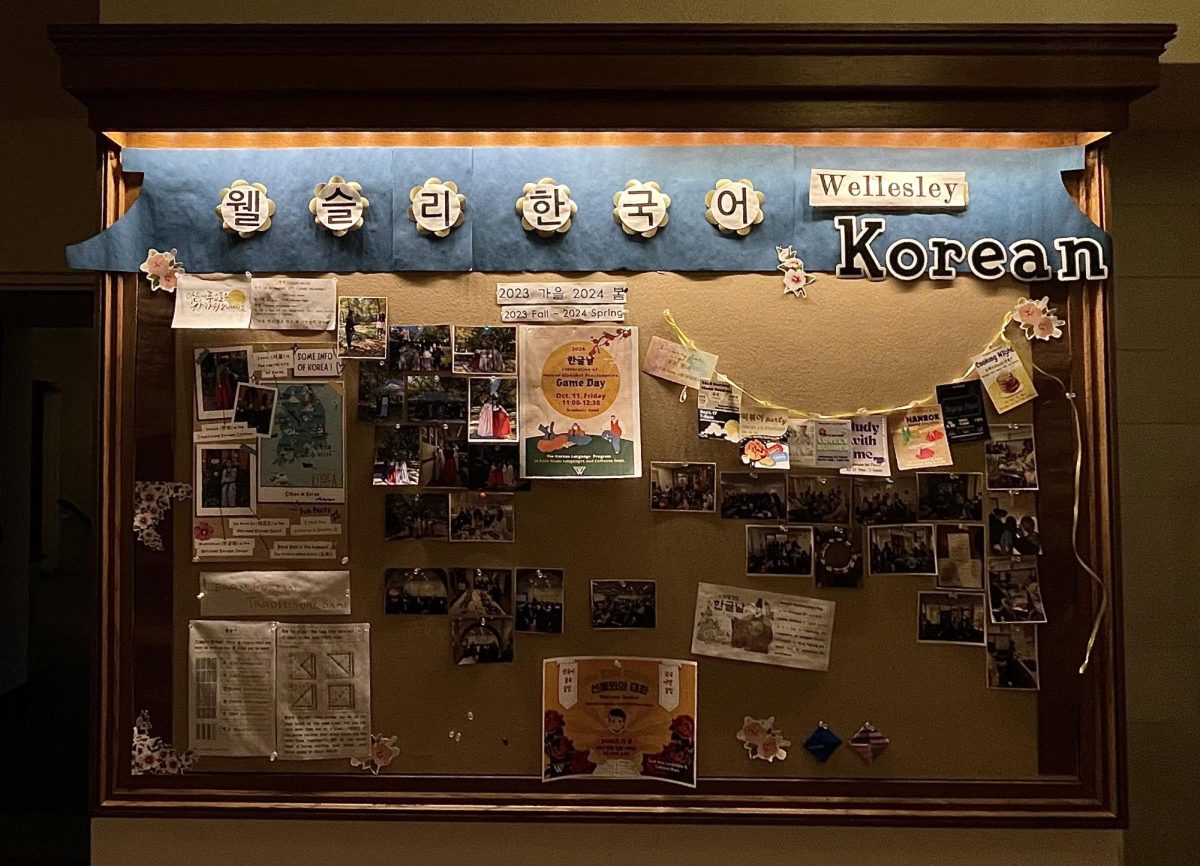
Growing student interest in Korean culture in general has also played a role in the proposal.
“We had started offering Korean language, which was well subscribed to, and then in recent years, the significance of Korean pop culture has meant that there’s quite a broad interest in Korea and Korean history,” Rao said.
Deborah Moon ’29, a prospective International Relations-History major and East Asian Studies minor, described feeling “quite concerned” about the “complete lack of Korean and Japanese history courses” offered.
“I do feel heavily underrepresented as a Korean-American attending Wellesley, and hope Wellesley’s administration understands that students cannot properly learn East Asia’s rich and diverse history at Wellesley when it is limited to one country alone, or if other countries are only taught in a comparative perspective, especially to the West,” wrote Moon in their petition response.
Many students involved in EALC say those gaps are already impacting their academic decisions.
Vivi Li ’26, a History major, recently took HIST 274, China, Japan and Korea in Comparative and Global Perspectives. Li noted that while the course covered around 3000 years of history from all three countries in a single semester, “a similar course on Europe would split this into 2-3 modules,” wrote Li in their petition answer.
“I feel that my depth of learning would be increased if there were more East Asian specialists,” Li wrote. “Not only because they can co-teach this content with another course offered the following semester, but also since they would provide another perspective as a historian primarily in Korean history rather than Chinese history.”
For other students, the sparse course offerings have already influenced major and minor decisions.
Joanne Kim ’27 wrote about studying Korean in their transfer application to Wellesley as a part of their 100-word essay. In their petition response, Kim wrote that the College’s decision to decrease the Korean and EALC department and program budget “made me reconsider my decision to transfer.” Currently, Kim is in the process of submitting a petition to complete their major.
“ I was not able to fully complete my major and was dissatisfied to take my major requirements as an independent study course solely because of the lack of KOR class availability,” wrote Kim.
Such constraints have even pushed students away from the EALC major altogether.
“We’ve heard stories of students deciding to minor instead of major because of course availability,” Hewang said. “It affects what people feel like they can commit to.”
Faculty note that the hiring request is taking place within broader institutional constraints.
“For a few years, the College hasn’t been hiring in the same way that it usually has … for one or other reason,” Rao said. “There have not been as many hires as had previously been the case, so I think everyone feels the sort of squeeze in that sense.”
If approved, the hiring process would still take several years. Even an authorization this year would only result in a hire no earlier than the 2027-28 academic cycle.
“If it goes on for too long, then we’re gonna have other needs. Other people will retire or leave and so forth,” said Rao. “I do think we will get someone eventually.”
For faculty, the petition is meant to demonstrate demand for sustained investment in East Asian studies
“It could demonstrate that there is student support for this position — that there is a kind of constituency for the kind of courses that this potential member of our department would offer,” said Rao.
For Hewang, the petition reflects broader concerns about the humanities at Wellesley.
“It’s kind of the chicken and egg,” said Hewang. “There are less people majoring in history, but there are also factors that are making it harder for people, less convenient and less appealing for people to major in these fields. So, if you want to keep these strong traditions alive, keep these departments robust communities and give them a strong future, you have to invest in them now.”
Contact the editor in charge of this article: Galeta Sandercock