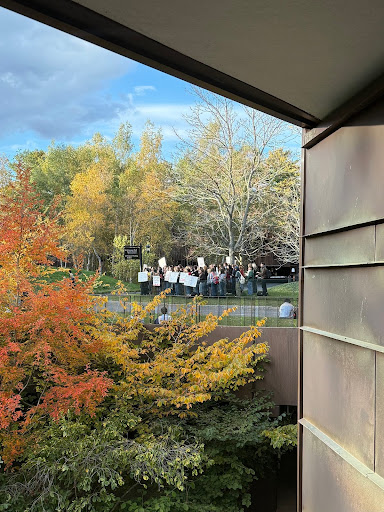
For students who care about public issues on campus or beyond, one recurring question is: how can we better engage and make a difference? One answer to this question arose recently, with this year’s Alumnae Achievement Award given to Sue Wagner accompanied by the protest and teach-in organized by YDSA (Young Democratic Socialists of America) at Wellesley. These events offer a chance for us to reflect on the broader landscape of civic engagement at Wellesley and how different organizations publicize their events. While certain activities achieve higher visibility, it is equally important to examine how information about other opportunities circulates, since limited accessibility or misunderstanding can prevent students from participating.
Since on-campus protest is a more public-facing form of direct action, YDSA’s protest of Sue Wagner naturally drew significant attention. The visibility of this protest, along with the memories of past campus actions, has prompted discussion about whether other forms of political engagement should be practiced more actively.
In this recent case, YDSA conducted informational campaigns to present context and evidence. They organized teach-in sessions aimed at deepening students’ understanding of activism at Wellesley throughout the college’s history and asked the broader questions of which alumnae’s work should be honored. These efforts are easier to overlook since they don’t create the same obvious, physical presence as protest. Beyond this particular moment, YDSA regularly runs reading groups that create space for discussing political theory, and, according to the club, they plan to host more discussion-oriented panels in the future. Despite the time put into these events, they fall under the category of regular “club meetings” since they are discussion-centered rather than action-based. As a result, these gatherings are less visible to those outside the organization and its email list, creating an unavoidable barrier that limits broader student participation.
Beyond YDSA, email functions as the primary tool for student organizations to promote civic engagement events: event announcements are circulated through club mailing lists that most students sign up for at the beginning of the semester during the organization fair. Although many events are one-off and topic-oriented, and certain volunteer opportunities are open to anyone interested, students who are unaware of these clubs or who hold misconceptions about them may not join the mailing lists in the first place. As a result, they may miss opportunities for civic engagement that actually match their interests.
Bulletin boards in residence halls and academic buildings serve as another channel for event promotion. However, unlike email, which students routinely check, students are often less motivated to stop and look at them. Their disorganized appearance can sometimes help students stumble upon unexpected events, but at other times can make it harder to find information amid the clutter.
At Wellesley, within the broad field of civic engagement, the political-engagement branch has a “half-centralized” information hub: the Committee for Political Engagement (CPE). CPE, an organization committed to connecting students to advocacy opportunities on and off campus through resource sharing, hosts its own events and highlights other events and political engagement opportunities from different clubs and academic centers on campus across diverse political topics. As part of the College Government, its newsletters can reach students across all class years, breaking the information barrier.
However, I describe it as “half-centralized” because the updates focus primarily on individual events rather than functioning as an “all-in-one” hub that consistently includes recurring items like weekly meeting schedules. Instead of gathering information in a fully top-down manner, CPE also depends on clubs proactively sending in their events for promotion.
While CPE’s consistent and effective weekly work promoting meaningful events deserves appreciation, we should also be open to imagining whether a more centralized and automated online platform could circulate all political-engagement-related meetings and opportunities, thereby reducing communication costs and search effort. The current club-centered model is reasonable, but it can unintentionally deter students who worry about long-term commitments or inbox overload. A unified platform that regularly lists organizations’ meeting times and highlights upcoming themes or events might complement the current system by lowering barriers to participation. Further, on a more macro level, we currently lack a student organization dedicated to gathering and publicizing not only political engagement events but also the broader range of civic engagement opportunities — a task that would require even more time and commitment.
After examining student-driven approaches to strengthening civic engagement, the role the College plays should also be considered. The office directly responsible for it is the Civic Engagement Department under Career Education, whose staff members work to provide advisory services. Students who already feel strongly about social justice issues may find the office when searching for related resources, but students who only have a vague sense of what they care about may not know the office exists. As a staff member mentioned, students sometimes mistakenly assume that the civic engagement department only functions to match them with volunteer opportunities, or that they must have a clear idea before seeking help. These misconceptions keep many students from reaching out.
In fact, staff members welcome students who simply come in with a question, confusion, or struggle. They are there to help students think more deeply about what they care about and how to care about it. If you find yourself having a moral struggle or want to advocate for an issue that you care about but don’t know how to do so more effectively, that alone is enough reason to reach out.
Furthermore, some highly valuable free services the Civic Engagement Department offers are still little-known among students. For example, they provide free vans for civic-engagement-related activities — as long as you have a minimum of three people, you can request a van, either driven by a licensed student employee or by yourself. While the department provides transportation for established long-term student volunteer programs, it also encourages individuals to pursue single events that they have a passion for. Staff are more than willing to offer personalized suggestions, so all students need to do is show up.
Still, another opportunity under Civic Engagement requires further examination: the Clinton Fellowship. Although its stated purpose is to help students build skills, gain exposure to strategies for impact and practice in constructive dialogue, it does not fully meet participants’ expectations. The program is free, but membership seems to be decreasing over time, signaling deeper issues.
In contrast, the Albright Fellowship, which shares a similar aim of supporting students interested in global affairs, has a much stronger reputation. While both programs are valuable opportunities for students passionate about civic engagement, organizers and students want their time and commitment to be worthwhile. It is therefore necessary for the institutional organizers to actively reflect on students’ dissatisfaction with the Clinton Fellowship and reshape it into a program from which students can genuinely learn how to better make an impact in civic life.
After looking at the broad landscape of on-campus civic engagement resources and their impact, the remaining question for all of us is how we can improve this ecosystem. From a top-down perspective, if you resonate with the idea of creating a collective information circulation platform, there is always room for community-driven innovation. From a bottom-up perspective, word of mouth remains unexpectedly effective. Wellesley is a small and closely connected community, so if you come across any opportunity that feels worthwhile, passing it on to friends over meals or walks can help information travel further than any poster or email. If you spot a problem, finding others who share the same concern and reaching out together can increase the likelihood of change. And if you ever need a place to say something out loud, The Wellesley News’ opinion section is available for you to facilitate the conversation.
Contact the editors responsible for this article: Caitlin Donovan, Avery Finley