Some sources in this story spoke on the condition of anonymity out of fear of retaliation for participating in the protest.
As families arrived on campus Friday afternoon for Friends and Family Weekend, around 30 Wellesley students staged a different sort of gathering: one of chants, signs, and speeches challenging the College’s decision to honor BlackRock co-founder Susan L. Wagner ’82 with the Alumnae Achievement Award (AAA).
The Wellesley Young Democratic Socialists of America (YDSA) organized an “Alum Achievement Award Counter-Space” at 2:30 p.m. on Oct. 24, after which the group marched to Alumnae Hall at 3:45 p.m. to protest the AAA ceremony.
The “Alum Achievement Award Counter-Space”
Around a hundred student demonstrators gathered in the Pendleton East Atrium for the AAA counter-space. The event began with student presentations detailing who Susan Wagner is, what BlackRock is, what BlackRock is invested in, and why YDSA was protesting.
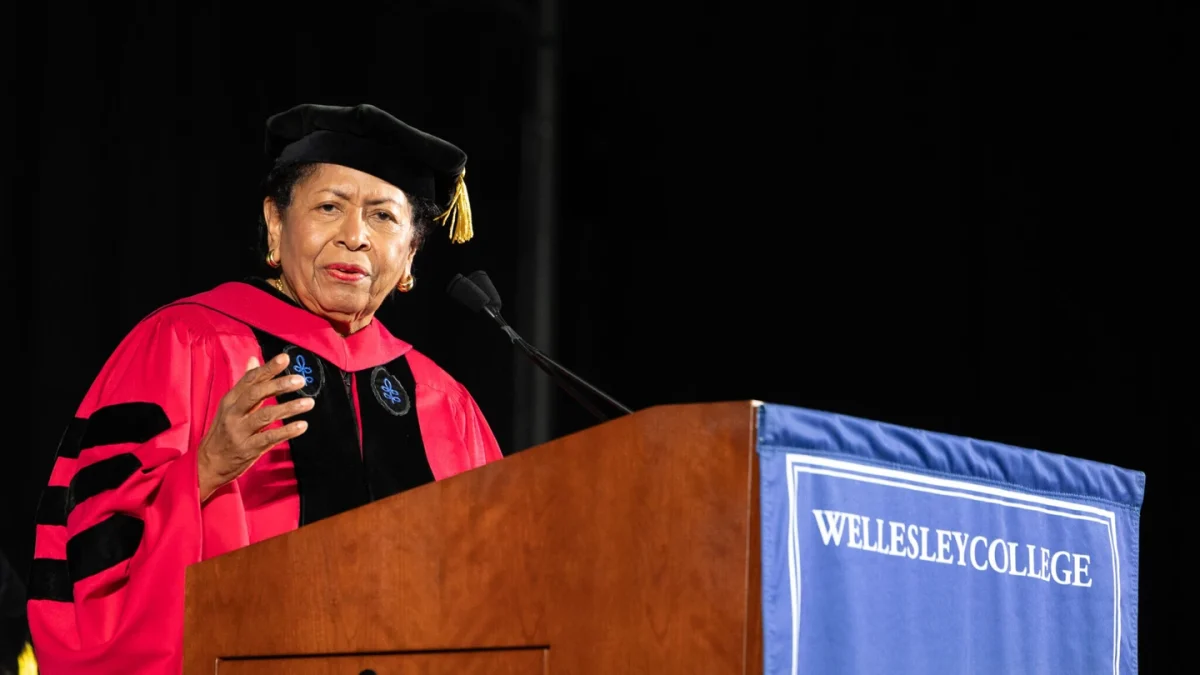
Several speakers then joined, including Massachusetts House Representative Erica Uyterhoeven ’10, who shared her experience as a legislator and former economist, particularly speaking about antitrust.

“There’s so many elected officials and leaders who are afraid to speak up,” Uyterhoeven said. “My question to them is if [you] cannot speak up when there’s a genocide and a clear apartheid, when are you going to speak up?”
Professor Sarah Chant, Visiting Assistant Teaching Professor in Women’s & Gender Studies, then discussed past solidarity movements to inspire students to continue the “work to make Wellesley the kind of place it claims to be, and the kind of place you want it to be.”
Following the speeches, YDSA hosted a Q&A panel with two representatives from the Alumnae Association Board, including AAA Selection Committee Chair Angeles Garcia Cassin ’09 and Senior Director of the Alumnae Engagement Helen Gregory.
In an email that YDSA co-President Abby Kubena sent to the YDSA mailing list at 11:32 a.m. on Friday morning, they noted that the Q&A was not originally planned to be part of the event.
“There were some last-minute additions to the schedule,” Kubena wrote in the email. “[Cassin and Gregory] will be coming to watch the teach-in and answer questions about how and why they chose Sue Wagner as the honoree this year.”
According to Kubena, Dean Sheilah Horton had alerted YDSA on Thursday, Oct. 23, that Cassin and Gregory would like to join the counter-space. YDSA rearranged the event’s agenda to allot around 15 minutes for Cassin and Gregory to speak.
Maple Bottinelli ’26, who attended the event, noted that Cassin spoke “the entire time,” and Gregory “just stood there and smiled, like grinned, nodding the whole time.”
“[Cassin] opened by saying, like, ‘I love that you guys are doing this’ and then she spoke about her time at Wellesley and how she incurred $10,000 of debt. So she was trying to liken herself to us, but then … was like ‘Once you leave Wellesley, you’ll have to be a financially literate person, and she started talking about investing with companies like BlackRock and Vanguard,” Bottinelli said.
As Cassin spoke, the room grew tense, with numerous students murmuring. People appeared upset with Cassin’s discussion on financial literacy, with one student raising their hand to say, “Who do you think you are talking to right now?”
“Basically, I heckled her, which was really bad form, but she was talking about building an investment portfolio and how we need to invest our money … Most people in this room are not in a position to build an investment portfolio,” the student said to The Wellesley News.
At some point, a YDSA member began clapping next to Cassin’s microphone to allow the event to move onto its next segment.
“Cassin said her opening remarks would be five minutes and then we would have time for a Q&A, and then she went on for 15 minutes, and we had to cut her off to get to the Q&A because we had a lot of people wanting to ask questions,” Kubena said.
Following Cassin’s remark, there was time for only one student to ask questions: “What are your criteria for selecting alumni who received these awards? Do you believe these alums accurately represent Wellesley’s motto of Non Ministrari sed Ministrare? Do you still believe Sue Wagner meets these criterias [sic], especially considering BlackRock’s impact on the atrocities going on in Gaza?”
In response, Cassin elaborated, “The reality is if you are a person outside of here in the world who is working, and you have a good sense of financial literacy, you will understand that your 401 is not going to cover your expenses when you are retired.”
She proceeded to discuss the importance of making “good choices about how to invest your money,” saying that companies like BlackRock help with such goals.
Many, however, appeared unhappy with Cassin’s response.
“When I was hearing her explain the process, first of all, it didn’t really make sense to me, but also, she kept avoiding every question that was directed towards acknowledging Sue Wagner’s company, BlackRock,” Aayshma Rai ’29 said.
Judy, a Wellesley parent who sat in at the teach-in event and wished to keep her last name anonymous for the safety of her child, shared some of her insights from the session.
“The professor who spoke was very educational and gave us a good history of Wellesley’s history in this space. I was quite disappointed in the representative from the Alumnae Association, who was a little patronizing in how she spoke to students that ‘once you leave you’ll realize it’s all about your investments and those are more important than anything,’” Judy said.
According to numerous students, Cassin and Gregory were later booed outside Alumnae Hall when they drove by the protest in a golf cart.
Contextualizing the counter-space and protest
YDSA’s “Alum Achievement Award Counter-Space” arrives following weeks of student pushback against Wagner’s receiving of the award, largely due to BlackRock’s investments in carbon-intensive companies and corporations financing Israel’s war in the Gaza Strip.
On Oct. 16, YDSA hosted an event titled “We say Boo! To Sue Wagner, Do You?” where attendees wrote letters “telling administration and the alumnae association why Sue Wagner wouldn’t be honored at this year’s alumni achievement awards.”

Then, sometime between Wednesday, Oct. 22, and Thursday, Oct. 23, mini zines titled “Congratulations, Sue Wagner … FOR FINANCING ECO-DESTRUCTION, MILITARIES, & GENOCIDE ” were anonymously placed on students’ dormitory doors. The zines cited BlackRock’s “Investments in Surveillance, Military Technology & Genocide,” noting BlackRock’s role as a shareholder with companies such as Palantir, Microsoft, Amazon, and Google.

The zine also included a QR code to an “Open Letter to Wellesley College and the Alumnae Association Denouncing Sue Wagner as an Alumnae Achievement Awardee,” which included a link to sign onto the petition.
In the days leading up to the AAA ceremony, YDSA “Call to Action” flyers saying “Walk with us after the teach in … show friends, family, administration, alum, and Sue Wagner that Wellesley students don’t stand by honoring financiers of genocide, deforestation, and human rights abuses” were placed all over campus.
The Protest

After the counter-space event concluded at around 3:30 p.m., students marched from Pendleton East to Alumnae Hall while shouting chants such as “Wagner’s legacy you can’t hide, BlackRock is funding genocide” and “Wagner profits, people die, we won’t stand and watch them lie.”
“We marched right in front of Alumnae. A few different speakers had small speeches, and there was a lot of engagement because it’s parents’ weekend. A lot of families drove by, and we got a lot of honks,” Bottinelli said.
Numerous parents, including Judy and her husband — who held a poster reading “Not a role model for our DAUGHTER!” — participated in the protest.
“I’m thrilled that [my daughter] is part of this protest, and we are here to stand with her, and we hope that Wellesley is listening. We need more free speech on campus,” Judy said. “What I would really love to see is students involved in the selection of alumni that they can look up to and that they think best represents the values of Wellesley today and not of yesteryear.”

One alumna cheered on the protestors as she entered Alumnae Hall to support another recipient of the AAA, Karen Grigsby Bates ’73.
“This was a really lovely moment. She was walking into Alumnae, and I think she wanted to clarify to us: she was like, ‘I’m with you. I have to go support my friend, but my heart’s with you,’” Bottinelli said.
However, some alumnae disagreed with the protests, pointing to Wagner’s long-standing support for the College and her efforts to advance women’s leadership.
“We have so much to thank Sue Wagner for when it comes to forging a place of impact for women in the workplace, for believing so strongly the need for women’s financial independence, and for her tremendous support of the College resources,” an alum from the class of ’91 wrote in an Instagram comment.
On the other hand, Patrick — a parent who also wished to keep his last name anonymous for the safety of his child — desired even more protest from the Wellesley student body in response to Wagner receiving the award.
“I would love to see the entire campus out. I would love to see them shutting it down. I mean, look, I know that Ms. Wagner gives a lot of money. I get it,” he said. “But at what price? How do we compromise our ethics?”
Last week, Kaya Perce ’26 emailed the Alumnae Office denouncing the Award Committee’s selection of Wagner. On Friday morning, she received an email from the Office explaining the AAA selection process.
“Sue Wagner has done much to earn the award. Beyond her many achievements as a business leader and trailblazer, she has mentored generations of Wellesley students and alumnae in finance and business,” the email wrote.
The News previously reported that the three criteria for AAA selection are outstanding achievement and distinction as trailblazers, inspiring students, and reflecting the diversity of Wellesley.
In the email Perce received, the Alumnae Office added: “While financial support of Wellesley is not a factor in the award selection, it is worth noting that Sue’s gifts to the College have made it possible for every student to have a career advisor and her vision also enabled the creation of the Wagner Centers for Wellesley in the World, which supports faculty so that their research will have a greater impact, and engages students and the community in ways that are felt beyond our campus.”
Patrick, reflecting on the College’s decision, felt he understood the reasoning behind honoring Wagner but emphasized the importance of including student voices in the conversation.
“I work in fundraising, so I get it. You want to honor people that have demonstrated a lot of commitment to the organization, to the nonprofit, to the campus, but honestly, I think a more comprehensive conversation should have been held with students,” Patrick said.
Some students echoed that sentiment, expressing frustration with what they described as a recurring lack of communication.
“I feel like the administration in general is constantly doing things that many students disagree with and I think these disagreements wouldn’t happen if they consulted students before putting on events before this,” a student protestor in the class of ’28 said.
Ultimately, regardless of differing opinions on the award itself, many expressed pride in students for taking a stand through the protest.
“I’m so proud of these young women right now. I swear it’s so easy to get discouraged these days, but when I see this, it helps me feel better about our future,” Patrick said.
Contact the editors responsible for this story: Jessica Chen and Galeta Sandercock