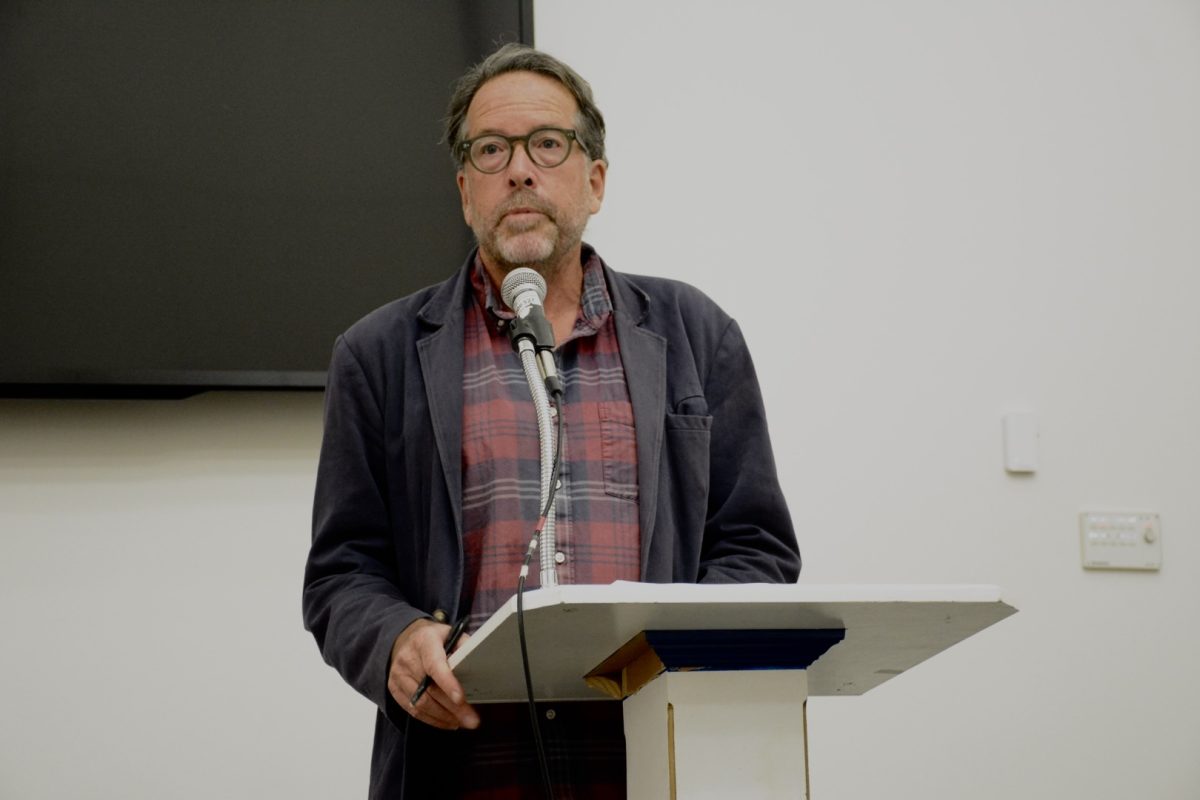
Journalist and author Todd Miller delivered the lecture “Climate Disruption, Migration, and the Rise of Walls” in the Pendleton East Atrium on Nov. 12, attracting a crowd of around 100 students. The atrium was so crowded that many attendees sat on the steps to attend the talk and the following Q&A session.
The lecture was part of a three-part series, “Climate Breakdown and the War System,” created by Peace and Justice Studies major Ilinca Drondoe ’26, who organized the events to highlight the connections between militarism and climate breakdown. Dondroe developed the series during an internship with feminist scholar and founding director of the Consortium on Gender, Security and Human Rights Carol Cohn and Peace and Justice Studies professor Catia Confortini.
The series, which included talks on militarization in the Pacific Islands and the environmental toll of war systems, aims to equip students with interdisciplinary tools to understand how environmental destruction and war systems intertwine. Dondroe says that she hopes these events will bring attention to the “often overlooked connections between militarism and the climate crisis” and inspire more transformative changes.
Miller’s talk focused on the accelerating links between climate disruption and the expansion of border enforcement. He opened with an account that became the beginning of his 2017 book Storming the Wall.
“I saw a man fishing by the shore nearby … the shore [has] come up considerably. [The fisherman] said, ‘It’s come up so much that we’ve had to move our houses back,’” Miller said.
Miller reflected on what the future holds for children in decades of rising seas. He said he thought about what might happen “in 10 years, 15 years, 20 years,” if families like that fisherman’s family must move again, perhaps across borders, to survive.
From there, Miller spoke about military and security assessments. He cited a 2008 report called Climatic Cataclysm, which brought together climate experts and defense officials to analyze the foreign policy implications of climate change. It presents three scenarios — expected, severe and catastrophic — to explore the potential consequences.
Miller focused on one author, former national security advisor Leon Fuerth, who warned that border issues could overwhelm U.S. capabilities and force countries into “nightmarish episodes of triage,” in which countries would face difficult decisions about where to allocate resources. Those decisions would fall the hardest on the poor.
Miller discussed the long-established connection between U.S. climate policy and increased border control.
“[National security reports] say that the United States will build ‘defensive fortresses,’ and quote, ‘Borders will be strengthened around the country, to hold back unwanted, starving immigrants,’” Miller said.
He traced the origins of this to a 1994 strategy called “prevention through deterrence,” which tried to reroute migrants from Central America to the deadly Arizona desert by funding walls, agents and surveillance in urban areas along the border. What began with a $1.5 billion enforcement budget has ballooned, he said, to about $30 billion today.
Miller discussed the worsening climate crisis and how it affects migration patterns.
“In 2016, in Mexico, I met three men, who told me they were coming from Honduras, from a small community where it hadn’t rained … there was no harvest, there was no food, and so they were in a crisis. They were an area known as the dry corridor in Central America. There were 400,000 people who were affected by this drought,” he said.
He linked the increasing hunger in Central America to broader patterns of climate stress and stated that U.S. agencies have long acknowledged this link.
“When the Pentagon assessments look at northern Mexico, the first thing they talk about is water stress,” he said.
He contrasted this recognition within U.S. security agencies with actual spending priorities. According to Miller, from 2013 to 2018, the United States spent “eleven times more on border and immigration enforcement than on climate finance,” which includes international adaptation and mitigation funds.
In response to a question about the logic of “the lobby to continue investing in customs and border protection rather than investing in climate security,” Miller turned to the entrenched nature of the current system.
“This increased border apparatus … climate has to be considered a huge part of it because in the world of increased displacement of people, it is like a scaffolding of the status quo … it’s like keeping the country, or the planet, in a straitjacket as we go into this 21st century, in a system that is ultimately unsustainable for life on Earth. But there’s only one way you can keep that system going — strangleholding the entire planet,” he said.
During the Q&A, Dondroe noted that government assessments often portray “poor and starving migrants” in ways that “depersonalize it entirely,” creating “this racialized image that is then deployed as a threat.”
Miller agreed, reflecting on the role journalism can play in reshaping how the public understands climate migration.
“I really think that journalism needs to step up … stepping up and seeing how things are presented and really challenging, how this is happening, is a super important part of what I hope to do. I feel very small, but I still go out there … And when you get the stories, [they] contrast the well-worn narratives … it’s a tonic to those narratives,” he said.
Miller closed by urging students to rethink the meaning of security amid accelerating climate pressures.
“There is always an opportunity to open up spaces,” he said. “When you open spaces, you can start thinking of things in different ways.”