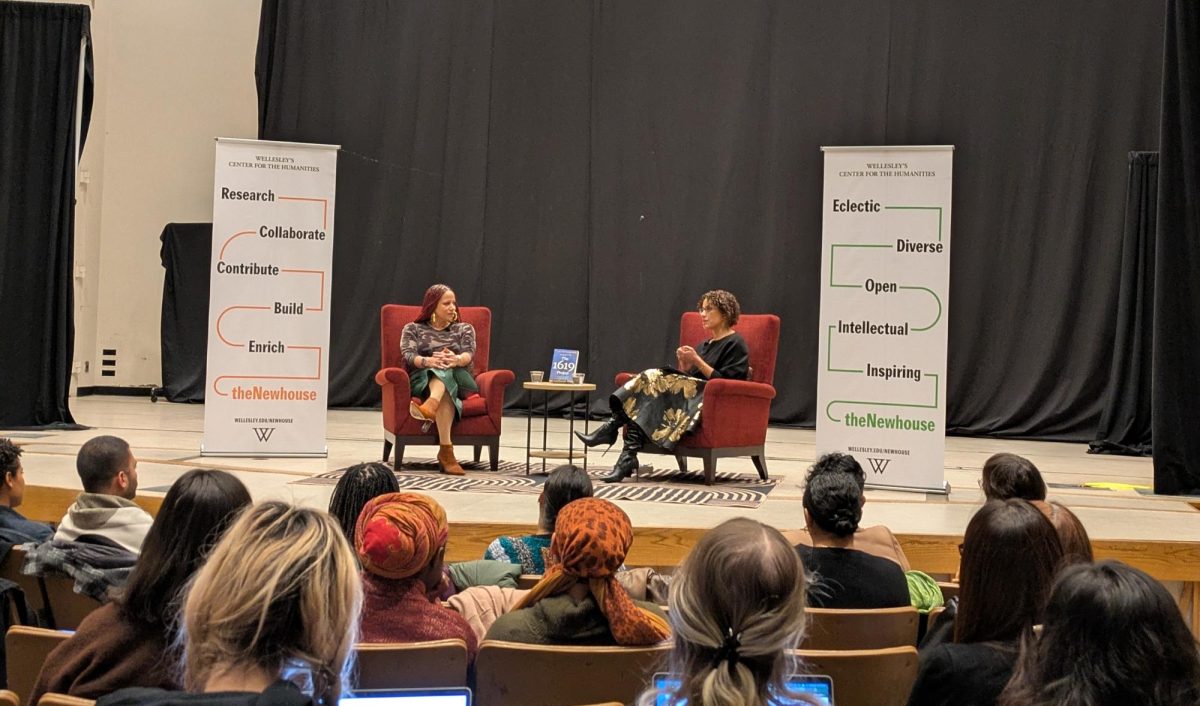
Pulitzer Prize-winning journalist Nikole Hannah-Jones, author of The 1619 Project, delivered the Elizabeth Turner Jordan ’59 Distinguished Lecture in the Humanities at the Jewett Art Center Auditorium on the evening of Nov. 12.
The talk was hosted by the Newhouse Center for the Humanities, with Hannah-Jones in conversation with Dr. Brenna Greer, Associate Professor of History.
Hannah-Jones is a staff writer for the New York Times Magazine and the creator of The 1619 Project — a project that includes essays, photographs and poems on the history and continued legacy of American slavery. The project takes its name from the year the first boat of African-American slaves arrived in North America.
Hannah-Jones recounted learning about the first 20 enslaved Africans who arrived at Point Comfort, Virginia, in 1619.
At the time, she was “in a white school, in one of the whitest states in the country,” and remembers being “instantly transformed by that knowledge.”
“What we commonly think of as history is really memory … That’s when I came to understand the tremendous power of who gets to control the narrative of who we are, and who we believe ourselves to be,” Hannah-Jones said. “So much of my career began in that moment.”
While The 1619 Project has acquired countless accolades for its magazine issue, book version titled The 1619 Project: A New Origin Story, and Hulu series, it has also received criticism from many individuals — including President Trump — who condemned the history it brings to light.
During a White House history conference on Sep. 17, 2020, President Trump criticized The 1619 Project, stating it was “totally discredited.” He further commented that it “rewrites American history to teach our children that we were founded on the principle of oppression, not freedom.” President Trump further threatened to cut funding from California schools incorporating the 1619 project into their curricula.
Despite these criticisms, and with support from the Pulitzer Center, The 1619 Project has been incorporated in over 4,500 curricula across the US, which is “what made it so useful,” Hannah-Jones said.
In response to the project’s growing popularity, numerous states introduced bills that effectively banned teaching The 1619 Project in 2021. States like Arkansas, Iowa and Mississippi also introduced legislation to restrict or ban the teachings of “Critical Race Theory bias,” with varying success.
Hannah-Jones questioned why Black history specifically was being erased in America’s political history, stating that “Black history is inherently political by definition.”
“The fact that the first Africans arrived here just seven years after the first English colonists tells you that these histories can never be disentangled,” she said.
In the final moments of her talk, Hannah-Jones pointed out that debates over The 1619 Project reflect larger debates of national identity in the US.
“We’ve all been taught the history of a country that never existed, and because of that, too many of us are not aware of what this country is capable of,” she said.
She argued that by placing slavery at the heart of American history, The 1619 Project achieved success by challenging the myths of “American exceptionalism.”
“Our very understanding of America has to evolve with the histories of Black people here, and that’s very dangerous to people who want to reinstate a golden era that never existed for us,” Hannah-Jones said.