The Academic Council voted on Dec. 11 to reject proposed changes to the College’s academic schedule for the Fall 2026 semester, following over an hour of dialogue, amendments and concerns from various faculty across departments.
The motion to adopt Option 6, with an additional amendment, was rejected with 57% “No,” 36% “Yes” and 8% abstaining.
A subsequent motion to create a new task force to more deeply consider a broader range of options to this problem was passed.
A survey was sent out to members of the Academic Council in early December. Of the 105 respondents, “52% indicated they do not want to see the creation of a new ad hoc schedule task force, whereas 48% of respondents said they would like to see a broader set of options considered,” according to the Dec. 5 memorandum, presented by the Agenda Committee on Dec. 11.
Faculty also voted between eight schedule options, each representing a different combination of three variables: start time, Community Time and Tuesday/Friday structure. Most options preserved Wellesley’s standard Monday/Thursday and Tuesday/Friday schedule.
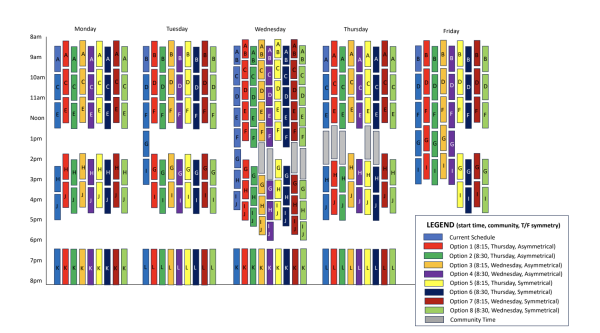
Since Option 6 aligned with the three most popular preferences — an 8:30 a.m. start, Thursday community time and a symmetrical Tuesday/Friday schedule — Option 6 advanced to a final vote against maintaining the current schedule.
Across the survey, all 8:15 a.m. options collapsed immediately, with only one respondent ranking any 8:15 a.m. as their top choice. The asymmetrical Tuesday/Friday schedule options also dropped early, with faculty voicing concerns about irregular block lengths and inconsistent midday availability.
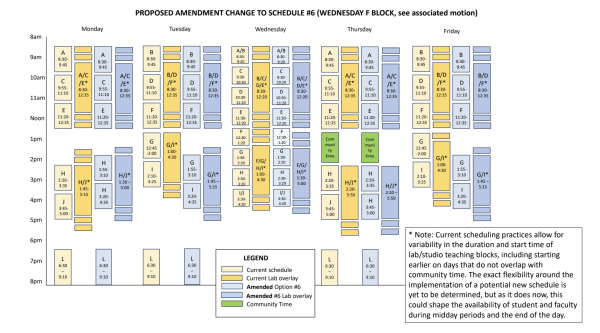
During the Dec. 11 meeting, Professor of Mathematics Alex Diesl introduced a successful amendment to preserve the current Wednesday structure in Option 6, maintaining the long midday break and earlier end time. The amendment passed after the faculty reviewed a handout detailing the modification.
In his presentation, Professor of Anthropology Adam Van Arsdale raised concerns about ongoing problems that cannot be resolved by changing schedules.
Van Arsdale additionally underscored the impact of afternoon labs on scheduling flexibility. Of all lab courses, an overwhelming majority meet in the afternoon, and most run 3.5 hours, creating structural problems that ripple into other departments. Van Arsdale remarked that faculty need to think about how to address these issues, beyond the schedule itself.
During the council, numerous faculty members raised concerns ranging from methodology to logistics. One professor cautioned against over-emphasizing the ranked-choice results of the survey, noting that preference ordering does not always indicate strong support.
Another faculty member expressed frustration with the limited range of choices presented, advocating for a schedule distributed more evenly across all five weekdays. Such a model, they argued, would allow for lunch periods every day for both students and faculty.
Several others raised concerns about work-life balance. One faculty member noted they could not support any schedule that would require working past standard child-care pickup times.
Another proposed that the College could consider reinstating older dining-hall practices, such as offering lunch foods in the morning, so students could pack meals for days with no formal lunch break.
In lieu of the numerous questions, some attempted to move to table the discussion. However, President Paula Johnson, among many others, questioned whether delaying was feasible given tight administrative deadlines — the College requires department chairs to finalize their class schedules and offerings soon.
Following the creation of the task force committee, faculty will return to brainstorming a new schedule next semester.
Contact the editors in charge of this article: Jessica Chen and Lyanne Wang