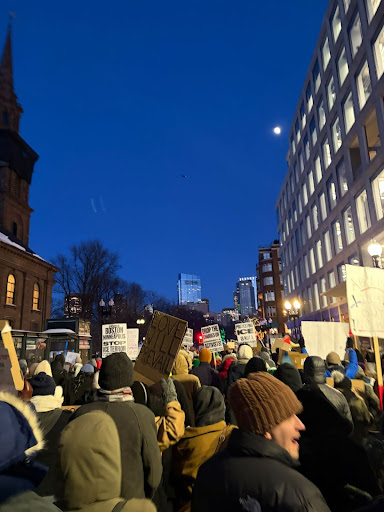
Snowflakes whipped against my face in the sharp wind as my friend and I stepped out of the Copley Square subway station. I pulled my coat tighter, navigating a path of slush and half-melted ice. Despite temperatures dropping below 10°F, thousands braved the freeze, filling the space around the Boston Public Library. Amidst the crowd, above a sea of winter coats and knit hats, signs and flags rose in every direction, thick black marker declaring “ICE OUT NOW,” “ABOLISH ICE,” posters marked by melting images of ice and urgency. This was the ICE OUT rally in Boston on Jan. 30.
The rally is more than just a snapshot of dissent. It is an entry point for us to take a closer look at the dangerous growth of ICE and the underlying forces driving its expansion. Moreover, it prompts a meaningful conversation that our student community could have: what it means to take a stand, and how we can make strategic efforts to show solidarity and defend our rights without risking our security.
The demonstration, titled “ICE OUT Everywhere,” was co-organized by several local advocacy groups, including the Boston branch of the Party for Socialism and Liberation and Mass 50501. The rally called for an end to state and local cooperation with U.S. Immigration and Customs Enforcement (ICE), stronger protections for immigrant communities and solidarity with Minnesota following the death of Alex Pretti.
The rally began at 3 p.m. in Copley Square with a diverse roster of speakers, including activists, student leaders, a congresswoman and a teacher. Their speeches were met with the rhythmic pulse of the crowd’s chants, drums and clanking percussion, bolstering the collective spirit.
At 5 p.m., the crowd began marching from 585 Boylston Street toward the Boston Common. For over an hour, under a sky streaked with the violet and pink glow of a winter sunset, the procession moved forward into the descending dark. Occupying the entire roadway, the sheer volume of the chanting made the movement impossible for onlookers to ignore. Marchers waved their arms and hoisted their signs toward the windows of overlooking buildings, ensuring their message reached those inside.
To understand this moment, we must zoom out beyond the streets of Boston and consider the broader reality of ICE today. We are witnessing aggressive deportation quotas, the expansion of enforcement into sanctuary cities and paramilitarization with little to no oversight. The long-standing, quiet expansion of mass surveillance capabilities, backed by massive financial and technological resources, is unthinkable. Meanwhile, this is further complicated by the contentious “absolute immunity” for federal agents JD Vance recently advocated for after Renee Good’s death. However, this claim faces heavy skepticism from experts. This issue remains trapped in a deeply unsettled legal landscape. The tension between Qualified Immunity and the push for absolute protection, the blurred line between federal authority and state power and the increasing difficulty to hold officials accountable in court make it hard to reach a clear conclusion on where legitimate law enforcement ends and a crime begins. In this intricate web of enforcement, we must scrutinize the administration’s narrative strategy: the creation of fear and hatred toward an always-shifting “other” and a logic of intervention inherited from the War on Terror. Only by examining these roots can we understand the cultural machinery driving ICE beyond mere policy.
In Boston, ICE has made arrests and detained individuals. However, the city has also actively pushed back. On Feb. 5, Mayor Michelle Wu signed an executive order prohibiting federal agencies from using city property as staging areas or processing centers for civil immigration enforcement. The order also commits the city to investigating criminal conduct by federal officials and releasing surveillance footage documenting violence or property damage caused by federal agents. Wu announced these measures alongside other municipal leaders, signaling a wider range of solidarity to protect residents.
Yet, even in a blue sanctuary city, anxiety is not easily soothed. For those in precarious positions, whether due to ethnicity or citizenship status, the fear of arrest and deportation presents a barrier to participation in public political advocacy. We live in a time when expectations for what we think the government can do are constantly shattered; every news cycle brings reports of such “unprecedented” abuses of power that leave one feeling a mix of absurdity and profound distress. Self-censorship emerges naturally. When the consequences of crossing a vague legal boundary are unimaginable and uncontrollable, silence becomes a survival skill, especially for those who are most vulnerable.
As an international student, the “hidden consensus” is clear. From parents and teachers to social media accounts targeting the international community, the advice is always the same: Do not engage. Do not march. Do not protest. There is a pervasive sense that, without citizenship, the right to advocate is not a luxury we are afforded. The lack of visible role models of people who share our identity and have safely navigated these spaces deepens the silence. The zone of self-censorship expands until it feels like our default setting.
However, we should remember the famous poem from Martin Niemöller:
“First they came for the Communists / And I did not speak out / Because I was not a Communist / … / Then they came for me / And there was no one left / To speak out for me.”
Of course, as students, especially as students who live with visa restrictions, our safety and visa status must remain a priority. But perhaps solidarity does not have to be an “all or nothing” act. Instead, it can be a mindful, strategic choice that takes many forms. We do not need to forgo the possibility of political engagement; rather, we can navigate it with caution. For me, this meant being intentional about my presence. Whenever a camera panned near me, I would raise my sign to highlight it while also shielding my face. I could show my support while safeguarding my future. It is a quiet yet necessary compromise that allows us to stand our ground without losing it.
“The weather is cold, but the struggle is hot.” That was my favorite chant of the day. May that heat stay with us all.
Contact the editors responsible for this article: Caitlin Donovan, Avery Finley