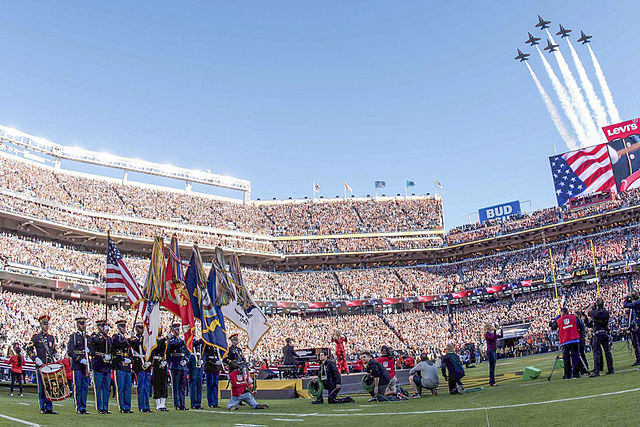
As I passed the McAfee common room, the TV glowed faintly as students gathered around the Super Bowl. It’s rare to see students using that room on a Sunday night to watch anything, and even rarer to see football on it. The halftime show starred Bad Bunny, making his way through a maze of sugarcane, flawlessly transitioning from one song to the next. The video faded with the words, “The only thing stronger than hate is love,” on the jumbotron. As I took my AirPods out and gradually returned to the world around me, I felt like I had just witnessed something magical. What I was watching was a symbol of the gradual process that’s been unfolding over the past few years — a fundamental shift in what it means to be an American patriot.
For years now, and like many students around me, I’ve felt ashamed of, disappointed in, and fearful of what it means to be an American. With Donald Trump’s rise to power, I began to associate America with hatred, violations of constitutional rights and disdain for its citizens, especially those deemed a threat to MAGA ideals. I never thought that the Super Bowl and its halftime show would be one of the things to reignite my faith in my country. As one of the most “all-American” pastimes, football has often embodied the toxic masculinity of the American patriarchy and seemed to lack a great deal of diversity. When I kept hearing Wellesley students talking excitedly about their plans to watch the Super Bowl and the halftime show, I realized that what it means to be American has fundamentally changed. While Trump’s America has consistently expressed contempt for the presence of immigrants, Bad Bunny’s performance embodied the idea that to be American and to be an immigrant are not mutually exclusive. His show displayed both the American flag and flags from Central and South America, including one from his home country of Puerto Rico. He had guests ranging from Cardi B to Pedro Pascal to Lady Gaga. His performance shone with his pride for Puerto Rico, and simultaneously, he told the audience that that cultural pride is what really makes America great.
Millions of Americans tuned in to watch the halftime show, Wellesley students included . Wellesley has often been considered a very liberal school, so much so that critiques of a strong conservative government can be read as unpatriotic. In fact, many liberals in general may describe themselves as unpatriotic. What the popularity of the halftime show amongst Wellesley. College students tells us is that to be an American is now defined by challenging the notion of the United States as a culturally homogenous state and to remain critical of modes of government that uphold that notion. To protest against the unconstitutional seizure of Americans and immigrants is to be American; to show up for your neighbors and care about your community is to be patriotic; to revel in the political symbolism in the halftime show is to be an American.
This seems to be a turning point in how we define ideas of American patriotism. The question is: where do Wellesley students fit into all of this? We are taught to be critical thinkers — we are encouraged to use our voices to show up for the communities we are from and care about, and to be vocal when we see those communities being harmed and targeted. What it means to be a Wellesley student hasn’t changed. Wellesley’s history of political activism remains the same. What it means to be an American, though, has changed.
Contact the editors responsible for this article: Caitlin Donovan, Avery Finley