Depending on where you enter the Museum of Fine Arts, Boston, you may find yourself funneled through a narrow corridor that bridges a gallery of contemporary photography and an expansive display of South Asian artifacts.
Thousands of visitors pass through it every month, often without realizing that while this hallway physically connects rooms, it also stages a geographical and historical transition. Much like how North Africa and the “Middle East” (or East Asia) form a landbridge into Persia and beyond, this passage at the museum creates its own crossing into a more interconnected version of “Asia.”
Within its confined space are numerous manuscripts, tapestries, calligraphy fragments and religious texts. Between them rest two pages from a 19th-century West African Quran, cataloged as 15.132. But this artifact is so much more than its description. Online, you can view the entire book; it appears modest at first, with a red leather-bound cover.

The book entered the MFA collection in 1915 as part of a gift from Denmnan Waldo Ross, a student of Charles Eliot Norton (Harvard’s first art historian) and a lecturer in art history and theory at Harvard University. Over four decades, Ross donated around 11,000 objects to the MFA, drawing from collections collected from his various travels across the globe.
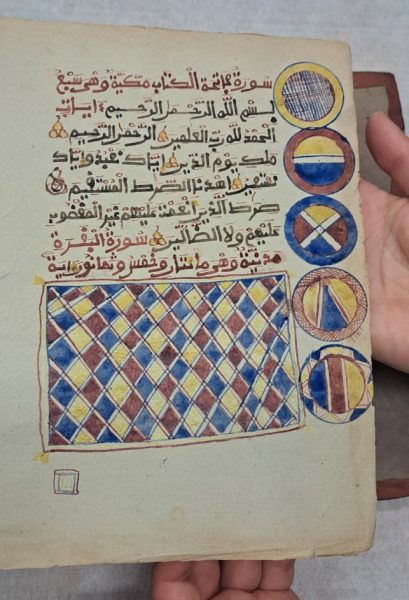
So why do we care about this Quran in particular? Well, because it complicates any notion of static tradition. Comprising 347 folios, the Quran is written in a West African Maghribi script called the Barnawi style, usually associated with regions of present-day Nigeria and Chad. Each page consists of 16 lines of text, with various colored symbols marking different things: diacritics appear in black, vowels are rendered in red, a specific sound (the “hamzat al-qat’”) is highlighted in yellow and decorative elements unfold in earthly colors, including brown, blue, yellow and black.
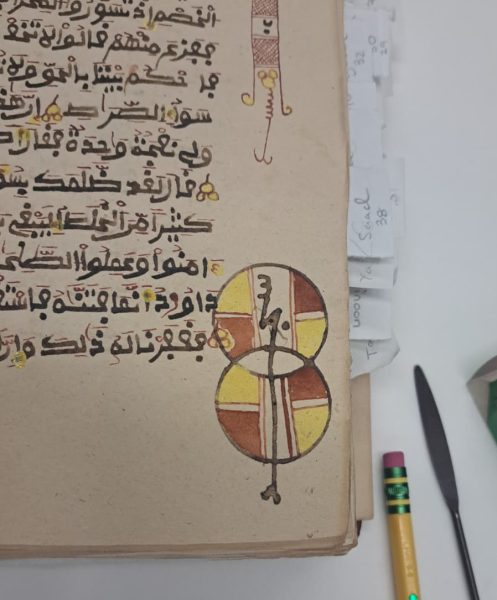
Every five verses, a small red mark appears. Every 10 verses, a yellow wheel motif appears. Larger more decorative circles recur approximately every 70 verses. Together, they indicate, to readers and reciters, the location in the Quran. Just a few times in the Quran, two overlapping circles occur, labeled “sajda” in Arabic, marking places where the reciter, and even the listener, are encouraged to prostrate.
Materially, the Quran tells a story of global circulation. Though assumed to be produced in West Africa, it is written on European paper, bearing a “tres lunes” watermark. The mark is associated with the Italian paper-making family of Valento Galvani in the Venice-Trieste region, and is widely found throughout the 19th century across manuscripts in Northern and sub-Saharan Africa.
In this sense, the Quran does not just represent religious tradition. It signals the integration of European materials into African production. This Quran becomes a record of trade and adaptation, and its analysis tells the story of global exchange and interdependence.
These explanations above only scratch the surface. Shockingly, little accurate scholarship exists on West African manuscripts such as this Quran. Attempting to research it reveals just how much African textual tradition is often understudied within art history. The most basic questions remain unanswered. Why, for instance, does this manuscript include a vibrant blue pigment when similar Qurans do not? Which regional scribe or individual produced it? What community used it, and how did it travel before entering Ross’s collection?
Despite these uncertainties, another question arises as two pages from this Quran sit in the hallway display. What is lost in the process of exhibition?
The manuscript was not meant to be a simply viewed object. The diacritics, the colored verse markers, sajda notations and fractional divisions all point to a living practice. Cultural and religious meaning is not just meant to be carried in its words, but in the act of recitation.
To encounter this manuscript in the MFA is to uncover different histories. In that hallway, it is labeled as an example of Islamic art. But it is so much more than that. This Quran has a layered history. It’s easy to overlook objects and artifacts, to misunderstand or ignore the importance and impact of art history. It also challenges us to reconsider how we encounter objects in museums. It challenges us to look past labels and turn a critical eye to how museums and art historians have historically interacted with African and diasporic artifacts.
My question then becomes: by placing two pages behind glass, does the museum render it accessible or invisible?