The men’s French national football team, Les Bleus, will train at Bentley University in Waltham during the World Cup this summer, despite having previously committed to training at Babson College. According to French football reports, the change was sparked by prolonged financial negotiations and an impasse between Babson, the French Football Federation (FFF) and FIFA.
Les Bleus are the top-ranked team in the World Cup as of April 14.
On March 26, Bentley’s athletic director, Vaughn Williams, announced that the French team will arrive on June 10 and train at Bentley for the duration of the World Cup. The university will serve as a training site that the team will return to, no matter how far they travel for their tournaments, which are scheduled to happen across the country.
During a media tour of Bentley’s athletic facilities, Williams noted the major areas where the French team would be training and practicing before their games, including Bentley’s soccer and baseball fields, the men’s ice hockey arena and athletic training facility.
Bentley’s ice arena is the first Leadership in Energy and Environmental Design (LEED) Platinum-certified standalone ice arena in the U.S.
Previously, on Jan. 20, the FFF had announced that Babson would host the French team for the summer. Wellesley community members had expressed excitement about the choice, with Wellesley Police Chief Scott Whitemore saying that the town would have a “significant role” in the World Cup.
However, Les Bleus called off those plans. According to L’Equipe, a French football newspaper, a financial agreement had not been reached between Babson and Les Bleus. Williams said he had no knowledge of why Les Bleus jettisoned their plan to train at Babson, and Babson declined to comment about the decision.
According to Williams, Bentley’s grass field played a large part in why the French team selected it as their training base, along with its proximity to Boston. Many soccer players prefer grass over turf for several reasons, including its lower injury rates and environmental concerns.
“There [are] not a lot of sites that have this type of [athletic] facilities, but also [with] grass pitches in this region,” he said. “There’s certain equipment that we have to use, certain different elements to make sure that [the grass] is playable the way it needs to be.”
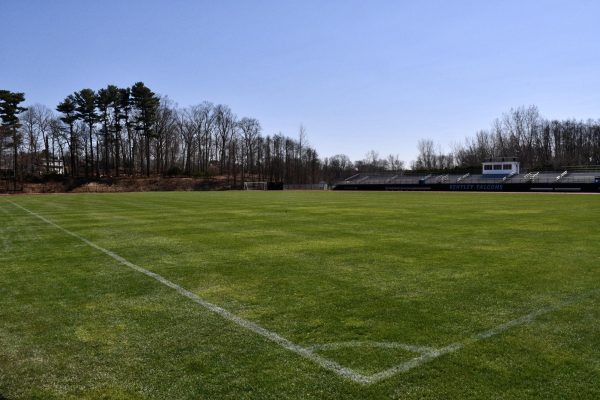
Eight of the 16 stadiums that will host World Cup matches this year require turf to be replaced with grass. Turf fields have increased in popularity in the U.S., with about 19,000 in the nation as of 2023.
Babson also has a grass playing field. National teams from Argentina, Costa Rica, Italy and the United States have previously used its facility for training.
Williams said that while Bentley’s grass field is off-limits to the Bentley community starting now, the track surrounding it is still able to be used by Bentley’s track team. Williams also noted that while sometimes the Bentley soccer team uses the field for practice during the spring, they will not do so this spring due to the field maintenance that has already begun in preparation for Les Bleus.
“We’re looking forward to getting this field prepared and [that has] already started,” he said. “We’ll protect this field until they come.”
Still, the French team’s use of the facilities will have a lesser impact on Bentley athletics because collegiate sports seasons will be completed before the team arrives.
Despite the short notice of Les Bleus’ upcoming arrival, Williams said the university is well-prepared to be used as the home base for the French team.
“Having a strong event management background myself, I’m not concerned,” he said. “Our people are diligent in detail.”
He also commented on the financial incentive for Bentley, saying that the university would not be earning significant revenue.
“There is a rental fee … [but] I wouldn’t say that this is a money maker by any stretch of imagination,” he said. “It’s [more] being involved in something greater.”
Contact the editors responsible for this article: Lyanne Wang & Jessica Chen