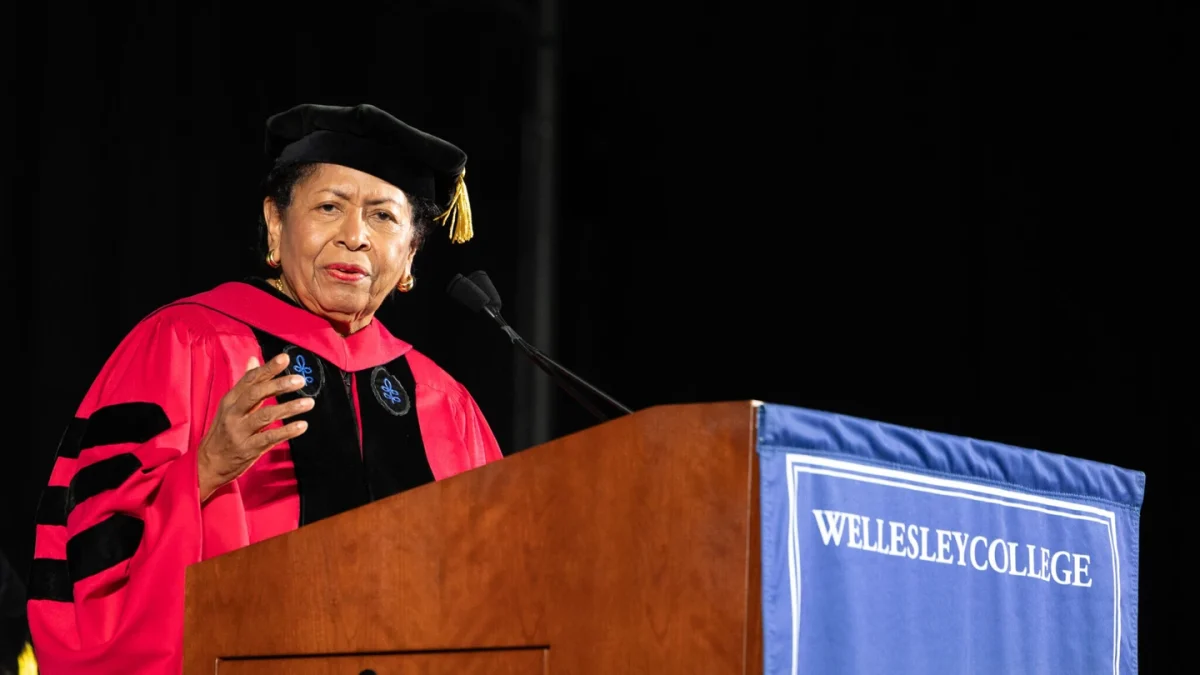
Dr. Ruth J. Simmons was recognized as an distinguished honorary alumna of Wellesley College in a special ceremony after delivering a commencement address to the graduating class of 2026 on May 15.
Following Simmons’ address, Wellesley College President Paula Johnson invited Simmons back to the podium to bestow what she described as “a special honor” in recognition of Simmons’ “groundbreaking leadership in higher education, dedication to expanding equity and opportunity for all students, and profound lasting impact on women’s leadership.”
“Because of these contributions, and the enduring bond you have to this institution, I hereby name you a distinguished honorary alumna of Wellesley college,” Johnson said.
The audience responded with a standing ovation before a visibly emotional Simmons.
Johnson then presented Simmons with what she described as “the keys to the college”: three ceremonial keys representing three central pillars of life at Wellesley.
“These keys each symbolize pillars of life & learning at Wellesley,” said Johnson. “The key to the dormitory, with a hearth for residential life; the key to the library, with an owl and a book for intellectual life; and the key of the chapel, with a cross for spiritual life.”
Johnson concluded by telling Simmons, “Today it is my honor to present these to you in full recognition of your time at Wellesley, and a legacy of advancing equity, opportunity, and excellence for all in higher education.”
The honor carried particular emotional significance for Simmons, who spent her junior year at Wellesley as a visiting student while enrolled at Dillard University.
During her address, Simmons reflected on her journey from growing up as the youngest of 12 children on a Texas cotton plantation to becoming one of the most influential leaders in higher education, since serving as president of Brown University–and the first Black president of an Ivy League institution–, president of Smith College, and the first female president of Prairie A&M University–a historically black university. She spoke about arriving at Wellesley in 1965, describing the experience as transformative and crediting it with helping her imagine a life beyond the limitations imposed by class, gender, and race.
“Wellesley, above all, was a place where I came to accept my role in the world,” said Simmons. “Not a limited version of it.”
Following Simmons’ remarks, Johnson’s closing address reinforced many of the same themes of civic responsibility.
Johnson urged graduates to reject individualism and apathy in favor of community-building and public service. Referencing Wellesley’s history of social reform and leadership, she called on graduates to help “realize the founding promises of the United States” and strengthen democratic institutions in an era marked by division.
Historically, honorary distinctions and degrees at Wellesley have been exceptionally rare. The College awarded its first ever honorary degree in 1921 to Marie Curie, making Curie the first recipient of such an award at Wellesley. The College had never offered honorary keys until now.
In an interview with the News before in April 2026, Simmons reflected candidly on what her return to campus would mean and the emotions surrounding her speech.
“It’s terrifying,” Simmons said. “I’ve probably given more than 50 commencement speeches to very large institutions… but I never felt threatened, in any sense, by being asked to be the commencement speaker.”
She explained that her nerves stemmed from the personal weight of returning to Wellesley.
“I think it has to do with how I value my Wellesley experience, and also the fact that Wellesley has never really kept in contact with me, or treated me like an alum,” Simmons said. “There’s been this distance that I felt between myself and this very important institution to me.”
The occasion served as both a celebration of Simmons’ legacy and a symbolic act by the institution.
Simmons’ used her address to emphasise academic freedom and the responsibility graduates have in extending those opportunities to others.
“Human potential develops not from attending certain schools or coming from certain rungs of society, but from having access to an environment in which the full measure of one’s promise is respected,” Simmons said. “If Wellesley has made you uniquely fit for these troubled times, make plain wherever you go and however you lead that your education derives from the privilege of academic rigor in the context of personal and academic freedom. Help others flourish by supporting the same for every child.”
Contact the editors responsible for this article: Ruby Barenberg, Lyanne Wang, and Caitlin Donovan