A missing ear, haunting portraits, swirling skies; the tragic “tortured genius” is how the public typically perceives Vincent Van Gogh. But perhaps, history should remember Van Gogh less as a legend, but as a profoundly human figure seeking his place in a community.
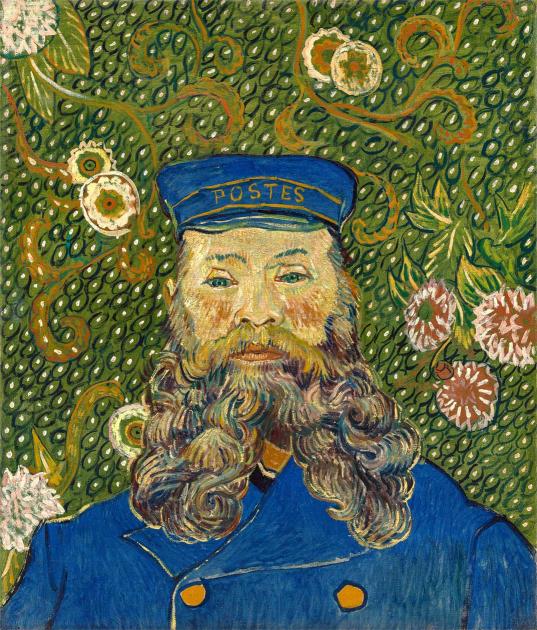
The Museum of Fine Arts Boston’s recently departed exhibition, “Van Gogh: The Roulin Portraits,” is an ode to the deep friendships and rich dialogues between the artist and his correspondents. Open from March 3 to Sept. 7, we bid goodbye to Postman Joseph Roulin (1888) and Lullaby: Augustine Roulin Rocking a Cradle (1889), some of Van Gogh’s most notable works from his portrait practice.
The exhibition opposes the well-worn narrative of the archetypal “mad artist” and breathes life into his character with a theme more warming and recognizable: friendship. From the Local Postman to the Postman’s wife and their youngest toddler, Marcelle, Van Gogh paints each of his friends center-stage, offering each a personal rendering of their identities. Van Gogh’s 23 portraits capture the intimacy of companionship and the hidden pangs of emotional underpinnings. In Lullaby, Augustine Roulin sits in an armchair, her hands grasping firmly to a cord attached to a cradle — a symbol of her steady maternal presence. His use of bold contemporary hues, her golden skin tone and stylized backgrounds dotted by flowers creates a halo-like aura. Van Gogh’s portrait of Augustine echoes that of Marian iconography, representing her in the universal features of motherhood.
Alongside his paintings, the exhibition featured memorabilia dating back to the artist’s admission into the psychiatric hospital: 10 intimate letters between the artist’s family and his friend Joseph Roulin. The inclusion of these letters expands the exhibition from stories in portraits to lived relationships. Roulin often writes about the family portraits hanging in his house that Van Gogh had gifted him, encouraging him to continue to paint as a way of taking care of himself and pursuing his passions. Here, Roulin emerges as more than just Van Gogh’s bearded subject matter, expressing his admiration and deep concern for his friend during his time in psychiatric treatment.
Despite never having been married or having had children, Van Gogh deeply desired the stability of the domestic household — emotions reflected in the family portraits he painted during his stay in Arles with the Roulin family. The exhibition comes full circle with his Self-Portrait (1889) and The Bedroom (1889), painted during his time in the hospital in Saint-Remy, capturing the artist’s perseverance in pursuing art despite his fragile mental state.
Seeking to find his place within the canvas of his world and its influences, the curatorial framework of the exhibition places Van Gogh’s painting within the greater dialogue of multicultural exchange. Drawing from Dutch art and Japanese woodblock print-inspired canvases, the gallery also recognizes Van Gogh’s profound desire to create a community of vibrant artists, as exemplified by his friendship with Paul Gauguin. Visitors are offered an immersive experience by stepping into “A Studio in the South,” Van Gogh’s unrealized space for collaborative talent. Yet beyond these global and artistic exchanges, the MFA gave visitors a chance to resonate with something more intimate and enduring: a wistful narrative of long-standing friendships that anchored Van Gogh’s artistic genius to its very core of raw emotionality.